The Man Who Killed the Video Game Industry - Howard Scott Warshaw
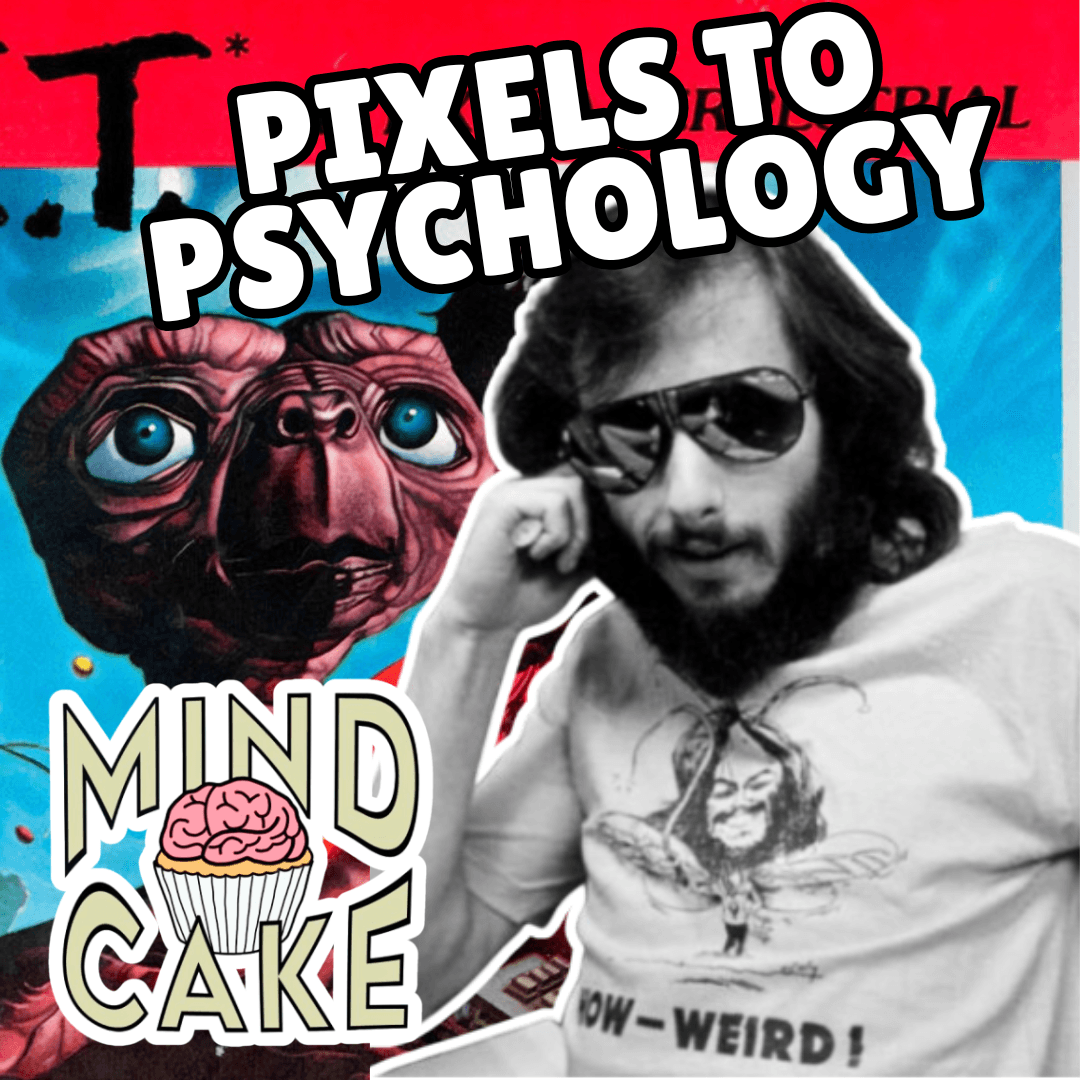
Howard Scott Warshaw created Yar's Revenge and Indiana Jones for Atari. He also created E.T. the Extra-Terrestrial — widely considered the worst video game ever made, blamed for crashing the entire video game industry, and the subject of a documentary about a literal burial in the New Mexico desert. He's now a psychotherapist in Silicon Valley. This is the story of how you go from making history to processing it — and what happens when the thing you're most famous for is also the thing you're most infamous for. Get his book: Once Upon Atari — How I Made History by Killing an Industry.
Listen on Spotify ↗Show Notes
Howard Scott Warshaw joins Mind Cake for one of its most unexpected conversations — from Atari legend to Silicon Valley therapist, via the worst video game ever made.
Howard created three games for Atari in the early 1980s — Yar's Revenge, Raiders of the Lost Ark and E.T. the Extra-Terrestrial. The E.T. game, rushed out in five weeks to meet a Christmas deadline, became notorious as the game that helped crash the entire video game industry. Millions of unsold cartridges were famously buried in a New Mexico landfill — a story documented in the 2014 Atari: Game Over documentary.
Decades later Howard retrained as a psychotherapist. This episode is about both halves.
In this episode:
— How Howard talked his way into Atari after being rejected for being too straight — What the Atari workplace was actually like in its heyday — Creating E.T. in five weeks and what that pressure felt like — The burial, the documentary and making peace with infamy — How he became a therapist and what drew him to it — Walking the dog, audiobooks and collecting 200 pages of ruminations — Why inspiration is his primary mental health tool
Timestamps 00:00 — Introduction 03:00 — Getting into Atari — rejection, persistence and the first day 12:00 — Life inside Atari at its peak 22:00 — Creating E.T. in five weeks 32:00 — The crash, the burial and the documentary 42:00 — Becoming a therapist 52:00 — Coping mechanisms — dogs, audiobooks and ruminations
Get Howard's book Once Upon Atari — How I Made History by Killing an Industry Available on Audible, Amazon and as paperback and ebook.
Transcript
Howard Stern: Initially I wanted to go to Atari simply because of technical work
I think we should start with, your backstory. And as I said a moment ago when we were just chatting, having recently watched the Atari Game over documentary, I'm not entirely sure where to start. So I suppose because the thing is, as well is like, because I grew up, I must admit, I don't hold this against me, but I was a Commodore 64 guy. So I'm interested to know what drew you to the video game industry initially and how did you land the job with Atari? Because presumably programmer, or whatever your title was wasn't really a job then.
>> Howard Scott Warshaw: No, there was no such thing as video game programmer as a job title at them. There were people who were doing it. But this was the dawning of a new medium. Yeah, yeah, the dawning of interactive entertainment. And that was huge. And that was awesome. And that was one of the things that really attracted me to it. But, initially I wanted to go to Atari simply because of the type of technical, technical work they do and the environment. So. And I only heard about it. I never, it never occurred to me to work at aar. That thought never entered my mind. I was working at Hewlett Packard. I was, you know, a regular software engineer, bored out of my mind because Hewlett Packard was big mainstream kind of stuff. And I liked obscure microprocessor applications, which in the late 70s were brand new and not many people knew about it. And I heard that Atari was doing m what's called real time microprocessor applications. That's what a video game is. and I thought, that sounds interesting to work on. And I was so bored. I was acting out a lot Atlet Packard. I was kind of a zoo case.
>> Howard Scott Warshaw: I'm 22, when I first arrived fue at Packeard with my master's degree and, all this stuff. And I'm ready to go and be an adult and pretend, you know, here we go. and I was bored out of my mind. And by 23, I thought, I can't keep doing this. I cannot keep doing this. And I was acting out a lot. And one of my, friends at work came and told me, you know, I tell my wife stories about you. They used tell Howard stories of you and ImpactKard. And he said, she says that's what it sounds like all the time where she works. I said, oh, where's that? And he said, atari. And that was the first time it ever Occurred to me that Atari was a place you could go and work. And so I thought, okay. And I went there and I talked my way into an interview, went through a whole interview cycle. And I thought, this is cool. And they make games. I mean, I wanted to do the kind of techk they do. I wanted to have a more wild environment where I would feel more normal. And, oh, yeah, they make games. I like games, but games were like the third thing. Most people there who were die hard gamers, I like games, but that wasn't. That was like the third on my list.
>> Howard Scott Warshaw: And we went and everybody. Everything seemed to work great, and it was a real rapport, and I was really excited. And then they rejected me. It wouldn't hire me. And, this became a very funny, story. I asked, why. Why don't you want to hire me? They said, we're afraid you're a little too straight for this environment. And that, over time, became a great joke. It became a very ironic, funny thing about it because I also became one of the wildest characters in a tar. but the thing is, I didn't get that at first. When I first showed up at aari interview, I put on my professional demeanor. I was a standard, very professional appearance. I thought, it's a job interview. I want to be serious. it never occurred to me that that would make it less likely that I would get the job in this case. And by being myself, being my real wacky self would have made a much stronger job interview. So when they rejected me, I did not accept m. I just pushed back. I said, wait a second. We're missing a great job match here. And I just wore him down. And eventually they gave me a chance. And the rest is literally history.
>> Howard Scott Warshaw: I think I know exactly what you're talking about. Also, I want to mention that I did write a book about all my experiences and everything that went on at Atari in my life at large. but Once Upon Atari, How I Made History by Killing an Industry. It's, a ebook, paperback, audioiobook. I narrated the audiobook myself.
>> Howard Scott Warshaw: Ok. And in this book, you will hear the following story. Okay, True story. The first day I went into work at Atari, because of what I'd gone through the interviews and made some real connections with some people, I was very aware that marijuana was something that was very significant in the workplace. Editor it wasn't mandatory, but it was a big resume item, let's put it that way. And so I rolled up a joint and brought one in that day. I thought just in case, you know, you want to be a cordial colleague, you know. And, I had no problem joining in the fun. And so I was carrying this joint around throughout the day and it was a wild day. There was a lot of interesting things going on. I was trying to read a lot and figure out and get my bearings there. And then towards the end of the day, I'm sitting in the office I was assigned to and one of the office mates comes blowing in and he slams the door behind him and he looks at me and he says, I'm going to smoke a joint right now, so if you don't want to be around this, you need to get out of here.
>> Howard Scott Warshaw: And so I pulled out my joint at this, but I figured this is obviously the time, this is the moment I pulled out my joint and I said, here, I said, I brought a joint. I'll be happy to share with you. And he looks at me and he pulls out a little plastic baggie and pops it out. And it is purple and green and smells like skunk and it's unbelievable. And he looks at me and he says, I'm going to smoke some real stuff here, no offense. And so I thought, okay, this guy's a pot snob. That's interesting. And so we went ahead and smoked his stuff and I thought, holy crap, this guy is not just a snob, he's a connoisseur. I really, his stash was so much better than mine that I realized if I was going to make it at Atari, I was going to have to up my game on every level. First day.
Can you walk us through the creative process behind developing Yar's Revenge
Can you walk us through the creative process behind developing let's say, Yar's Revenge, which became Am I wr? And saying one of Atari's best selling games. I'm interested because'm, I work in construction, but I write and I write scripts and I'm interested to know how you will come on to ET but when you supp. Certainly when you've got a short amount of time to do something. But how do you start. Is it the story? Is it the programming? Is it the, you know, the visuals? what does that look like?
>> Howard Scott Warshaw: Well, the creative process is something I've spent a lot of time in my life studying, engaging in, trying to perfect. So it's nice, it's lovely that you ask me about this. Something I really enjoyed talking about.
>> Howard Scott Warshaw: So the creative process for yours revenge, specifically for my first game is interesting because in order to get into Atari, right, I said they had rejected me. I finally wore them down and basically what I agreed was take a 20% cut in pay and go on probation for six months that I could prove myself. And within the first few days of my being there, they assigned me a game that was a Star Castle. It was a coin op that they wanted converted to the 2600. And so you'd think, well, if I'm on probation and all this, the first thing I need to do is just do the best job I can at doing whatever it is they're giving.
>> Howard Scott Warshaw: But that's not me. Okay. I don't believe in a thing called malicious obedience. Malicious obedience is when you know something is going to be a disaster, but you do it anyway just to prove to somebody they were wrong. And I don't believe that. So I looked over the game. I didn't know everything, but I read the manual, I understood the hardware enough to know that this game was going to suck. This game would absolutely suck on the 2600. And there was no way I was going to allow my first game to suck. So what I did was I prepared an alternate design and I went to the hiring manager, the guy who hired me, who gave me a break, who told me I'm on probation. I said, you know, this thing, excignment you gave me, I don't want to do it. I don't think that's a good idea. And he's like, really? You know? Yeah. I said, I think, I think it's going to suck. I did lay it. I said here's why I think. And he understood the machine enough. And I said, but here's something I think would work better. This had nothing to do with yourars revenge at this point. This is purely, purely my intuitive approach to what I think would make an interesting visual screen experience. That's where I'm starting. And he, to his credit, said, okay, go for it. So we blew off the coin up and I got to start working on my first game. Talk about a sink or swim situation. Yeah, yeah. Defitely I Tell him right off the bat, this thing you said, that's going to make me determine whether I could be here or not. I'm not going to do that. I want to do something entirely else. But with the 2600, the straightforward stuff to do is something like combat, where you have just two tanks and each of them shoots one missile at the other, one at a time, and you run around a course play field. That's what the machine is designed to do.
>> Howard Scott Warshaw: That's not what the machine is capable of doing, but that's what it was designed to do. Yeah. The real creative challenge on the 2600 is not to just take a few simple elements and try to make a new game out of that. The real creative challenge, and this was just clear to me right at the start, the real creative challenge is to find something new you can do in the corners, in the dark spots in web, the cobweb corners of that machine. Because that machine was primitive, but it was wide open and you could use it and you could abuse it and you could do weird things. So there's this weird hybrid between super anal, intimate technical detail and outrageous creative possibility construction. And that's where a video game on the 2600 list, you need someone, what they used to say is, you need someone who's both anal and silly. You need someone who's enough of a nerd to really get into the bit by bit details of that chip and at the same time be wacky and performer and artistic enough, to be able to turn some of those bits and bites into an interesting experience. And so that's because that's me, that's where I was coming from. I'm a nerd infused with ham. That would be a good description of me. So, my thing was to go. And I love puzzles, I love solving problems, I love finding new ways to do things. That's just something that turns me on. So when I started to do things with the 2600, the first thing I did was I looked for cool stuff to do because what I wanted was to put something on the screen that people could not walk by. Uh-huh. They would have to go, whoa, what's that? And some of the first things I put on the screen did just that. And people would come up to me and they'd go, wow, that's cool. What's that? And they're like, this new guy, what the hell? It's like. And they go, that's cool. And I go, yeah, cool. You know, and they go, what does it do. And I said I don't know, I don't know yet. Just because I wanted first I wanted to put some cool things on the screen. I had a vague idea of, you know, what you want to do. And then over time, see my feeling is you create capacity, you create capability and then you figure out what to do with it. Now that's one take on the creative process. Which was your question. Right. I mean a lot of people in the creative process pick a goal and then all their focus is how do we get there?
>> Howard Scott Warshaw: In an early stage creative process, if you already have a really clear target that you have to do that.
>> Howard Scott Warshaw: But if your goal is just to create something new, which at the dawning of a new medium, nobody knows what to do, nobody knows what you can do. So what's your job? What's your job description? What are you trying to do? What? My job description is that I get up and I go to work and on a good day when I leave work, there is something now that exists that did not exist when I got up. And that's a cool job description for me. I love that. So that's where I start.
Yar's Revenge was all about expanding what was possible on the machine
So instead of having a goal like a specific game design and just try to work towards that, what I'm thinking is first you expand your horizons and then you see where that takes you. What does that suggest to you? Like some people in writing, a lot of writers, when you're writing fiction, what they say is you don't focus all on the story, focus on the characters, develop the characters and after a while the characters will tell you where the story goes. It's a similar kind of thinking. And so I wanted to create new capabilities and just cool stuff. Like I said, you put me in a visual medium and the first thing I want to do is something that's visually exciting and intense. A lot of people when they start development, they put a square and a dot and they just start moving those around to test gameplay.
>> Howard Scott Warshaw: And for me, I don't want to stare at a square in a dot. I want something more interesting just to keep me engaged while I'm sitting there working. So I put this stuff up and I'm getting cool feedback and people love it. But I still haven't really solved the question of what the hell do I do with it. And in point of fact, the first actual playable game version that I had had a horrible, controller scheme and there's a number of things and basically I was sitting on a game that looked cool but Sucked. And I thought, oh God, I didn't want to do a game that sucks. And now my game sucks. And that was a very depressing moment.
>> Howard Scott Warshaw: Sure looks good. Oh baby. And so now I'm a victim of my own avarice and what am I going to do? But I consulted some people, made a few tweaks, and I made a major gameplay change because of some of the tweaks I had to make. Because as I said, there was, as I eliminated problems, things that didn't work. You know, there's an old Sherlock Holmes quote, I believe, which is actually an Arthur K. Doyle quote, I guess.
>> Howard Scott Warshaw: Which is after eliminating the impossible, whatever remains, however improbable, must be the truth. Yeeah. Right. And so I started removing the things that didn't work and then I had problems to fix. Right. Because the things that I removed still had to be there. They just weren't, they didn't work the way I had them implemented. And what I did was take some things off the controller because I didn't have the controller space for them anymore. And I wrapp them into the gameplay. And that turned out to be a wonderful game design thing to do. If you want to do something in a game, make it a behavioral exercise as opposed to a button push and people will be more compelled. It makes for more compelling gameplay. And I made those tweaks. And then suddenly people love the game. I mean, it wasn't just, oh, that's better, it's like, you're like, oh my God. And I thought, holy crap, this is amazing. And that transition from sucking to being fabulous and still looking good was like. And then suddenly. And now at this point, there's still no such thing as Yar's Revenge. Right. So the thing I want to emphasize is that the creative process with this game was all about expanding what was possible on the machine first, finding things you could potentially do, finding new ways to do them. And because I, first and foremost, I'm making a game, wanted to make a game is fun to play when I got to that point. Then you start the branding.
>> Howard Scott Warshaw: And that's what Yar's Revenge is, a branding that sits on top of just a gameplay.
There's a discussion about branding in the book about video games
And there's another thing I discuss in the book. There's kind of a fun discussion about the idea of does branding make a difference? Is what you call a game or how you define the characters in a game, does that really make any difference in the gameplay? And I give a really great example of a very simple gameplay and Three different interpretations o one of them which would villainize the game, one of which makes the game super heroic and one where it's just the game plan. It's a very, it's a fun contrast, I think. But for the creative point, it's just if you're making a video game, my feeling is what you need is a fun game and then you put a story on top of it. If you're doing a license like when I did Raiders of the Lost Ark and ET there's not much question about the branding. Right. We know where that's going. But I prefer original games. In an original game, the branding is a big part also. So typically we did the game, then we turned it over to marketing and they do their thing, they name the game and they do the box art and they put it out there.
>> Howard Scott Warshaw: When you feel you're a solid creative person, you tend to have boundary issues and control issues. Let me just put it that way. Y and so the boundary issue part is great because that's what encourage that's people with boundary issues of the kind who don't get stuck in typical ways of thinking and do find new ways of approaching things and new applications for old things. So that part comes in really handy. The control issue thing isn't necessarily as fun for other people in a lot way. When it came time to name the game and I found out for marketing, well, they're going to go name the game. I thought to myself, I don't think these people marketing are really that creative. This is my first game. I feel like I finally got to good game. I need to make it great. I need to be involved in every part of it. So I asked the marketing rep, look, can I submit a branding and a naming for the game? And he goes, sure. He goes, but you don't have much time. I said okay, this is like in the afternoon one day, come back tomorrow morning, I'll have something for you. He's like, okay, no problem. Said, will that be too late? No, that'd be fine. Okay, cool. So he takes off. I sit around and I go through this whole process of what am I going to do? How am I going to name it? I always remember the story of how the word quiz came into existence.
>> Howard Scott Warshaw: Which was in London. I think it's a good story, but it's just when you try to create a new word.
>> Howard Scott Warshaw: Everything come up with sounds stupid to me. It just sounds, it doesn't sound right. And eventually I gave up the idea but one of my bucket list items has always been to add a word to the English language. For some reason I always thought that would be a super cool thing to do. And I realized that if this game goes on and becomes really popular like Pac man has, this is my chance to add a word, you know, whatever the character name is, if that becomes a known character, I will have added a word to common parlance. And how, how cool would that be? So, so I thought instead of just making up a name, I thought, let me use algorithms like a good programmer don't for the name. And I thought, what's something that's just undeniably Atari, that's got a lot of status and power. And I thought, well, Ray Kazar is the CEO, so that's a pretty significant term. So I thought, okay, well let's, let's do a cipher, right? So we'll spell it backwards. You know, Ray spelled backwards at Yar. And I thought, yar, that's good. That's got sci fi kind of a ring to it. And Kazar back. Whereas Rayak, you know, I've got Z's, I've got Y's, you know, if you have X, Y's and Z's, you're in sci fi. That's the way I always think of it. So I thought, yeah, there's yardss and there's this Raz act solar system. And so and I started to build this thing and then I thought to myself, you know, there's an old saying that, you know, you could steal more money with a gun and a briefcase than you can with just a briefcase.
>> Howard Scott Warshaw: And I thought I could if I had a story, a whole backstory, in addition to just the name of the game, wouldn't that be a stronger submission? So I sat down and I worked all night. I was, and I just wrote down and wrote a 12 page story called the Yariian Revenge of Ray Act 4. And I thought, because revenge is a great title word because who doesn't want revenge? You know, And I've got the character name with Yar, so I'm liking this. So I wrote a whole story and I put it all together and then I had the people come type it up in the morning. And then the mid morning, here comes the guy from marketing. Boom. I give him the whole submission and he takes off later that afternoon. I love this story. Later that afternoon he comes back because this was my marketing plan to out market, market.
>> Howard Scott Warshaw: Exactly. I'm look at it as I'm Marketing my proposal to marketing. So he goes back that aftern. I said, is it in? I said, is my pro. He goes, yeah, it's submitted, it's in, it's under consideration. I said, okay, cool. I said, no, I'd like to tell you a secret. I said, but I don't want this to influence the naming. So you've got to promise me you'll keep this to yourself. He goes, okay, I promise. No problem. So I said, okay. You know that yar thing? He goes, yeah. I said, spell that backwards. What's that? you Ray. I go, right. And Ray Zak, right? What's that? He thinks somebody goes, Kazar. And he goes, ray Kazary. Does Ray know about this?
Yards Revenge was the first video game to have a backstory
And I said, well, of course Ray knows about it. You know, I wouldn't do anything like this without raise knowledge. But that's why I don't want you to tell anydy because I don't want it to unduly influence the decision making. Okay? Because that wouldn't be fair. And he's like, okay, so I swear him into secrecy twice more. And then he goes on his way. At this point, I know three things for sure. One, I know he is going to run right back to marketing and tell everyone. No doubt in my mind. Two, nobody in marketing has the balls to go and talk to Raar about this. And that's a good thing because three, I totally pulled this out of my ass. Rightar knows nothing about this. And he goes off. That's it. Ah. And then late the next day, he comes by, he goes, guess what, Howard? He goes, we're going to go with yardss revenge. And I said, oh, that's fantastic. And I was tempted to say him, you didn't tell anybody, did you? But, I just, I didn't want to push it that.
>> Howard Scott Warshaw: But I just figured, wow, I made it. That's.
>> Howard Scott Warshaw: And what I didn't realize was I had invented the backstory in video gaming. That was the first time a video game actually had a backstory and the whole yards revenge lore. And now there's the yarniversse and. And there's things potentially expanding that whole concept. But I had done the first real branding and original story creation and invented the backstory. Yours. Revenge had a lot of firsts. I mean it was first full screen explosion, first game with pause mode was. There was a lot of very innovative things that I didus was the first 2600 game with PAO the paradigm for home games. Was based on coin op games. Right. Whenever there's a new medium the first thing people do is they copy the old medium. That'because they don't know what to do with the new medium yet it's new. So we always copy the successes, the old media. So point op games was a newium but home games was a different. It was actually a slightly different medium. And so with home games you don't. In point op games you're never going to have a pause mode because you need people to keep dropping quarters. That's your revenue.
>> Howard Scott Warshaw: With home games you get, you pay one bag of quarters. That's it. Yeah, right. So the model, the economics of it is different. I always felt you can ask more in terms of learning curve, with a home game because people have already bought it. They're more committed to try and figure out what's going on with the game and get value out of it. But if you can make a game a little more complex, you can make a better game, a game that deeper, with better legs and so that easy to learn, tough to master. I was more like, well, maybe a little challenging to learn but tough to master. Ye and get a deeper game. And and some ways that worked, in some ways it didn't. But that was. The thing is I was, I am a boundary breaker. I always want to do things in the way you don't expect. You know, whenever you ask me for something, I'm going to give you the thing that could be an accurate misinterpretation of what you said. Just to make the point that, you know, you weren't really being that specific.
>> Howard Scott Warshaw: Yeah, yeah. Now there's a name for that. It's called being a dick at. But something that computer programmers do. Go ahead. I'm sorry.
>> Howard Scott Warshaw: What are they afraid they're going to discover something? I mean, frequently what it is, is they're afraid someone is going to exceed them in some ways. And instead of having expanded and found something positive, which is what a creative person would celebrate. Yeah, they're a little too much about, wanting to control the world and having recognition of their own as opposed to earning it. And as you might guess, I don't do very well with those sorts of people.
Steven Spielberg asked you to do the ET Game in five weeks
So after Y's Revenge, and, this is where we start to get to the crux of things. You did ET I.
>> Howard Scott Warshaw: Well, after that, I did Raiders of the Lost. Start.
>> Lee Crontpon: Sorry, Sorry. Which was also another huge hit. And am I right in saying that these things normally take five or six months to do, to develop at least?
>> Howard Scott Warshaw: Well, Yards took seven months. Raiders of Lost Ark took ten months.
>> Lee Crontpon: Okay, and then so somebody comes to you and says, we need ET and we. And you've got. How many weeks are doing?
>> Howard Scott Warshaw: Five. Five weeks. Not months. Five weeks.
>> Howard Scott Warshaw: No one had ever done a game in less than four or five months, I think at the absolute tops. And they wanted a game. Not just a game, but the biggest license purchase in history, and they were going to give it five weeks. So, as you might well imagine, there's quite a bit in my book about that too. Can imagine the whole ET Fiasco. But it was an interesting thing because I did Y, and that was extremely successful. And then I did Raiders, that Lost Ark, which was the first, movie to game conversion.
>> Howard Scott Warshaw: I did that. And that worked so well for Steven Spielberg that he specifically had asked for me to do the ET Game. And so the CEO Ray Kazar. That's the very beginning of my book is the phone call from Ray Kazar when I'm sitting in my office just towards the end of Raiders of the Lost Ark, saying, hey, we need ET in five weeks. Can you do it? And I told him, absolutely, I can do it, provided we reached the right arrangement. and it was, and it was, you know, I don't know what exactly I was full of, but whatever it was, I was overflowing with it, that point. because I truly believed I could do it.
>> Howard Scott Warshaw: And because I needed a challenge after having done those two like I did yardss. And that was really good. Which made me very, very nervous because now, you know, having. If you never get a hit, you know, oh, well, it didn't happen for me. But if you have a hit, suddenly the only thing I hear in my head is one hit wonder, one hit wonder, one hit. Is that all you've got? because when you get a hit, you attract enough attention that people want to know if you can do anything else. And if you there. In my mind, there was always something more pathetic about the one hit wonder than somebody who never did anything. There was just something weird about that. Somebody had one idea and that worked.
>> Howard Scott Warshaw: So that was my fear. And then I did Raiders and that was very well accepted and that was a success. And I thought, okay, now I'm two for two. Now I can't afford to miss because you know, with me there's always something to worry about. So it's like, so what am I going to do? I need a challenge. I need a real challenge. I was just thinking my mind, I need a real challenge. And then I get this phone call, can you do this game in five weeks? And there was a part of me that just said, I absolutely have to do this. I have to do this.
>> Howard Scott Warshaw: Right. The issue was. So this is July 27th. I remember because this is three days before my 25th birthday.
>> Howard Scott Warshaw: I'll never forget this stuff though. It was July 27th in the afternoon, got a call from Ray Kzark. Can you do it? This was a Tuesday. I said, absolutely, I can do it. He says, okay, great. He goes, Thursday morning, 8am There will be a Learjet at San Jose airport. Be on it. It's going to take you down to Steven Spielberg where you're going to present the design for the game. So not only do I have to do the game in five weeks, I have less, I have 36 hours presentation to prepare the entire design and a presentation. I mean if you think about if you're going to do the game in five week, you better not take much more than that to do the design. But that's not a lot of time to design a game. so I went through, and I'm very clear on all this in the book about the whole, you know, people go, what were you thinking when you made that game?
>> Howard Scott Warshaw: I tell, this is what I was thinking, this is the whole explanation because there is a very elaborate and clear line of thought that I went through to arrive at a design. Because if you're going to, if you're going to try and program a game that usually takes six months, in five weeks, You're going to fail. That's not going to work. No one is going to program, do six months worth of work in five weeks. Just not going to happen. So what you need to do, it's not a programming problem, it's a design problem. What you need to do is instead of trying to take a six month thing and squeeze it into five weeks, you've got to take something you can do in five weeks and produce that at the highest level of quality you can. And that's what I did. So I tried to design a game that I felt would still be a full substantial game, but the components of it could be done in a short period of time. And that was I used that kind of analytical thinking to create the design for it. And once I had the design stipulated, I just executed the design which I plan to be able to be done way.
Said: I delivered 100% of the initial design for ET
And so you most creative endeavors are what I would call a voyage of discovery. Right. What it is is that if you take the initial design of something, especially successful products, if you go through history, you look at some major successful product and you look at the original design and blueprint and you look at the final product, you will see there's a vast differenceah. And the difference is it got better as you go along. You you learn things, you discover things, you find where the blind alleys are and you do better, you improve and update the design as you go. So one of the biggest problems with ET and it's kind of a funny way to think about it, one of the biggest problems with ET was that I delivered 100% of the initial design.
>> Howard Scott Warshaw: And yeah, so you wouldn't think. How'd the project go? Well, I delivered 100% of my initial design. Oh, that's too bad. That's a bummer. But what it means is there was no room for rumination and updates and improvement of the design. There was no room for learning curve. It was just a sprint marathon and it was brutal. But I did deliver and it passed quality assurance. And I did meet that standard. I put a game out and even after all the returns, ET still sold like over a million and a half copies. In fact, all three of my games that were released at Atari were million sellers. I think I'm the only programmer who can make the claim who did more than one game. who can say that every game they released was a million seller. Wow. So I got that going for you.
>> Lee Crontpon: Got. You got that going. Steven Spielberg said that himself. He loved the game.
>> Howard Scott Warshaw: He did. He loved that game. He got paid $22 million to love that game, I got to say. So I could understand him really enjoying, really loved iteah.
>> Howard Scott Warshaw: The worst, worst video game of all time. You don't have to be shy about it. I'm not shy about it, believe me. In fact, the truth is, I prefer when people recognize. Do I believe it's the worst game of all time? Absolutely not. And many people will tell you there are far worse games than ET. But I do everything I can to preserve ET's reputation as the worst game of all time. Because I yar Revenge is frequently hailed as one of the best games of all time. So as long as ET is the worst, I have the greatest range of any designer in history. And I'll take that.
How was your mental health during development of Once Upon Atari
Switching them from mental health. And I suppose you're going to have to help me out here a bit. From what I suppose firstly, how was your mental health during that five week period when you're, I mean, I imagine under a lot of huge pressure to get the game out?
>> Howard Scott Warshaw: This is major subject matter for Once Upon Atari. Absolutely. My book. Uh-huh. Is that you wouldn't know what to talk to me, but I'm a pretty easy going, fun guy generally.
>> Lee Crontpon: I kind of get that Vi and.
>> Howard Scott Warshaw: Anybody who knows me will recognize the gravity of this statement is that I was losing my sense of humor by the end of this, this thing and I was snapping at people occasionally, which is something I never did. I never do. I because I had just finished a 10 month slog on Raiders, the lost Ark. That was a really difficult project to pull up and at the end this was right on the heel. So after a 10 month thing with no break where I should have taken a vacation and gotten a break, I capped off a 10 month real, you know, like death march with another five week insanity. And it did gradually drive me crazy because the need that I had to make this work to make this happen and the idea that I knew I had a development system moved into my home so that I would never be more than two minutes away from when something hit me to be able to actually enter it into the game. so I was working at home. I was working at work, but only occasionally. I began the whole work from home thing.
>> Howard Scott Warshaw: No it wasn't. And there's no Internet so strictly sneakeret. Right. So every once while, once or twice a week I would go into the office to update the copy of the game there to get a fresh listing so I could be reviewing the code.
>> Howard Scott Warshaw: Yeah, very primitive stuff. But the only time that I was more. It would take me more than a minute or two to go do something the game if I needed to, was when I was literally driving between work and home, which was the only thing that I did. there were people who were assigned to make sure I was eating, taking occasional shower, like trying to make sure I wasn't completely pile driving myself into the ground. Almost died twice. Tw There were two times I almost died driving back and forth because I was programming in my head instead of watching traffic lights. And I very nearly had a couple of major accidents that might have delayed the project.
>> Howard Scott Warshaw: No't. And it's like it was so intense and I was so committed. I think it was the hardest five weeks I have ever worked in my life. Brutal.
>> Howard Scott Warshaw: And I was already a little exhausted after Raiders. And then after that I was burnt out. I mean I was, I was so burnt out and so backwards in my head and already starting to think so much about oh my God, what am I going to do next? Because once I accomplished ET And we hadn't had any negative feedack because also, you know, back then you don't drop the game and get, you know, a couple of thousand opinions in the first few hours. This was going to be months before it was going to be able to hit shelves and people were going to be able to play it. So it was a huge success for quite a while. So I got to finish the game, I got to experience it as a dramatic success. The first thing ATARI did was they sent me to Hawaii for two weeks all expenses paid. Is like a thank you for the game. in Hawaii. I kept calling back into the office, hey, what's going on? What's happening? I was so antsy to get back. I left Hawaii early. I couldn't relax in paradise. Ah, basically I was that wired after that. And when I got back I couldn't really do anything effectively in the office either. I was just incredibly burnt out. And it took me a couple of months, at least to actually recover from having done that game. To recover mostly mentally and spiritually to get my spirit back. It did take a little while. It was intense. It was one of the most profound drops I've ever experienced.
>> Lee Crontpon: I don't want to liken it too it sor of an Olympic athlete, but you hear about these Olympic athletes who've been training and training and training for the Olympics and then they get to the Olympics and they win the gold medal and then, oh, what do I do now? You know, you've worked and worked and worked. You've got the game out in five weeks.
>> Howard Scott Warshaw: It's E.T.
>> Lee Crontpon: The biggest film. It's Steven Spielberg. Oh, o you want me to sit quite on a beach now in Hawaii and do nothing? It's like, you know what, what you bloody likely.
How did you feel then? How long was it until the reviews came out
How did you feel then? How long was it until you got to the reviews and then how. I mean, how did that affect you?
>> Howard Scott Warshaw: It's interesting because everybody thinks, oh my God, you know, you must feel very self conscious or down or off about made the worst video game. if I would have finished the game and everybody would have, oh, we hate it sucks. This is horrible. M. I don't know how that would have gone. What happened was I finished the game 9-1- ye and everybody was cheering. I mean literally cheering. Every Atari was cheering. We did it, we made it. We got this game out. Then it went out and I, you know, sort of tried to decriify for a couple of months. And so here's October and November. And now November is Starting to hit stores, and it's getting exciting. And then in the beginning of December, I get to attend the London premiere of ET Where I sit three rows in front of Lady Di and Prince Charles and Steven Spielberg. So they got to watch me watch the movie. I thought that was fabulous. So. And there's a lot of hoopla. And then the Billboard, magazine's ratings come out, and both Raiders of Lost Ark and E.T. are in the top 10 of video game sales. I have two of the top 10 games on the list at the same time. Y. I am not feeling like a failure at this point. I am smoking big cigars, as they say. This feels really good.