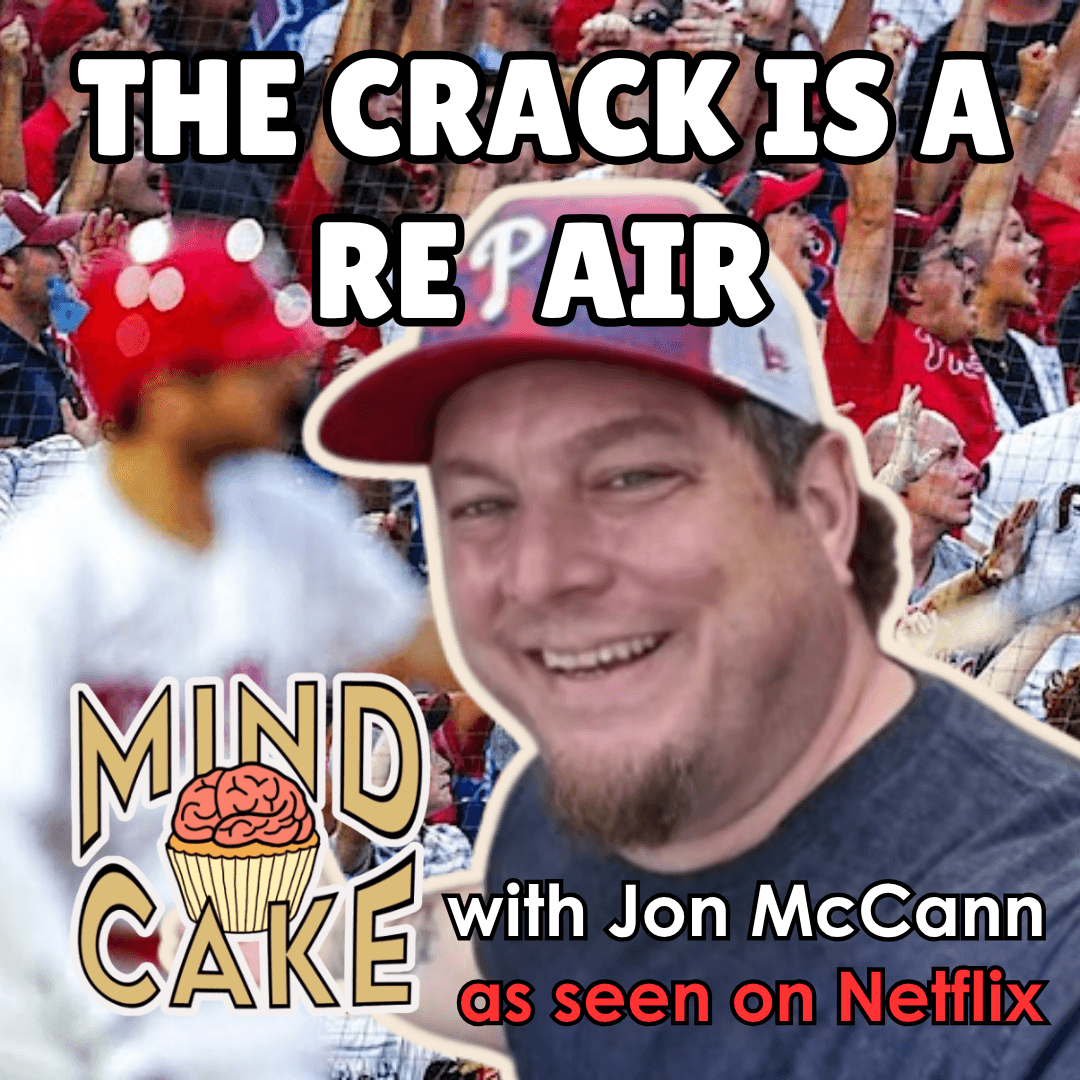
The Crack is a Repair
What happens when a city famous for booing its own players decides to cheer instead? Jon McCann is a Philadelphia Phillies superfan, YouTuber and the man behind one of sport's most remarkable stories. A social media post that turned a struggling baseball player's season around and became a Netflix documentary. But behind the viral moment is a deeper story: a breakdown, a mental institution, and the unconditional love of two parents who refused to give up on him. This is one of the most honest mental health conversations we've had on Mind Cake, about empathy, survival, therapy, and why the crack in the Liberty Bell is actually a repair. If you're coping with anxiety or looking for a mental health interview that actually moves you, this is it. Mind Cake is a comedy wellbeing podcast exploring honest mental health conversations and the stuff that actually helps, without the therapy speak. As seen on Netflix.
Show Notes
When Phillies superfan Jon McCann watched his beloved baseball team's star signing Trey Turner struggling through the worst form of his career, he made a decision that would change everything. Instead of joining the chorus of boos that Philadelphia sports fans are famous for, Jon took to social media and called on 45,000 fans to give Trey a standing ovation. Not just for one at bat, but for an entire weekend.
What happened next became The Turnaround, a 25-minute Netflix documentary that's been watched multiple times by people who can't quite believe what they're seeing. But the story behind the story is even more powerful.
In 2012, Jon's life fell apart. His marriage was ending, he faced losing his children, and he suffered a breakdown that led to a stay in a mental institution. The people who pulled him through were his parents, their unconditional love the thing that kept him going when everything else was gone. It's that memory, triggered by a single text message from a friend mentioning the words "mental health," that led directly to Jon making that post about Trey Turner.
One of the most honest mental health interviews you'll hear, and it starts with a baseball game.
In this conversation Jon and Lee talk about:
- The standing ovation that turned a season and a career around
- What it really means to support someone at their lowest point
- Jon's breakdown, his parents' unconditional love, and the year he wasn't sure he'd survive
- Decades of therapy and what it actually taught him
- His autistic grandson and the patience he never knew he had
- Why he stopped watching the news and why he thinks the world is losing its humanity
- Robot taxis, driverless Ubers and gaffer tape vigilantes
- The Liberty Bell and why the crack is actually a repair
"Sometimes being supported instead of being told you suck, sometimes you'll get good results if you support them."
If you're coping with anxiety, navigating your own mental health journey, or just looking for a conversation that reminds you why empathy matters, this one's for you.
Watch The Turnaround on Netflix: https://www.netflix.com/gb/title/81945091Follow Jon on Instagram: @thephillycaptainJon's YouTube channel: https://www.youtube.com/ThePhillyCaptain
Mind Cake is a comedy wellbeing podcast exploring honest mental health conversations, resilience and the stuff that actually helps, without the therapy speak.
Transcript
Jon McCann is the author of a remarkable documentary about the Liberty Bell
Lee: Okay, so today, mind cake is. I am very excited because I've been trying to get him on for a while. He's a very elusive man. Mr. Jon McCann. How are you?
Jon McCann: I'm feeling very elusive, but not too elusive because you got a hold of me, today. And, I am happy to be doing this with you now.
Lee: I'm, I'm delighted you're on Jon. For those who don't know, I heard of Jon after the, I have to say, remarkable documentary on Netflix called the Turnaround. So the Turnaround starts with the Liberty Bell. Tell us about the Liberty Bell and the unorthodox way to fix something that's broken.
The Turnaround is a documentary about Philadelphia sports fans
Jon McCann: So the, the movie is, the Turnaround. It's on Netflix. It's 25 minutes long. you've seen it three times, which I've only seen it five. So that's how good of a movie it is. People have watched it multiple times, and it's only 25 minutes long. The movie is about how two years ago or three years ago, there was a baseball player who the Phillies signed to a really lucrative contract. His name was Trey Turner, and he signed a 10 year or 11 year, $330 million contract.
Lee: Wow.
Jon McCann: And, the year prior, the Phillies were in the World Series, and they were just, it felt like they were one piece away from winning the World Series. And we thought when the Phillies signed Trey Turner, that would be it. We would, we would, you know, be the best team in baseball. We have Trey Turner, we have Bryce Harper. Unfortunately, Trey Turner had, I think, like the worst four or five months of his career when he started his career in Philadelphia. And Philadelphia sports fans around the world have a bad reputation. We're pretty much known to be brutal fans. As a matter of fact, that the work, the world premiere of the movie the Turnaround was at the Telluride Film Festival. And when you go to this film festival, they have all these movie stars who are all these movies, and they take a picture in a group photo. And I met Robbie Williams, the, the British singer. He had that, that movie out and his movie was premiering at the film festival with him as a monkey. And it was the monkey movie. Exactly.
Lee: Yeah.
Jon McCann: So I'm in this group photo with Robbie Williams, Will Ferrell, Angelina Jolie. And I like the one song Robbie Williams has, Millennium. I remember that song, Easeless too. So I walked up to him and I said, yeah, guys, you don't know who I am. I know who you are. I'm never going to have this time to Talk to you. So I just want to say hello. And I told him the premise of the movie. I was like, yeah, the movie I'm in, I'm, a Philadelphia sports fan and we, you know, we boo our players. And what I did was instead of booing Trey Turner, I made a social media post calling on all Philadelphia fans to give Trey a, standing ovation for not just one at bat, but for the entire weekend. Because he was playing so bad. I knew the Philadelphia sports fans were going to boom. And Robbie Williams looked at me, he goes, oh mate, you blokes are really, hostile in Philly. And I was like, I love, I love that he knew that about Philadelphia sports fans. So what? And that's what happened. I made that post. I said, hey, let's do a standing ovation for Trey all weekend long. And, we did. And he turned his season around and the Phillies missed the World Series by a game. But, you know, it shows that no matter who you are and what you're going through, sometimes being supported instead of being told you suck or you're not a good person or you're bad at your job, giving people support at their lowest, sometimes you'll get good results if you support them.
Lee: I say. I. I've watched it three times now. I watched it again this morning because I knew I was going to talk to you. That moment when I mean that, it's just very cinematic. I love the whole thing. I love, you know, we'll get onto your storey as well as part of the documentary. But that moment, that very first standing ovation, it gives me goosebumps. Presumably you were in the stadium.
Jon McCann: What I do for a living is I'm a YouTuber, so I document my life every day. I've been doing it for about seven years. Every day I make a video and a lot of my videos are at the baseball stadium. I go to about 50 to 80 baseball games a year and I make a vlog about it. So I was there the entire weekend for the standing ovation. You can see everybody, everybody sitting with me. They're all my friends. We sit together almost every game. They're all wearing Trey Turner jerseys. Word was getting around on the radio stations and people were talking about it on social media. Word was getting around that people were going to be doing the standing ovation thing. I thought it would be like maybe 5,000 people who would do it, but when the whole stadium did it, it was a pretty cool thing. I have a friend who watches every game with Me. And after. After it happened, he said, that has to be one of the coolest things an athlete has to experience, like performing poorly and getting that standing ovation. After it happened, Trey Turner bought billboards around the city thanking the fans. He gave interviews, saying he thought it was awesome that it happened. So, yeah, it was. It was great. It wasn't. It wasn't. I didn't expect it to become a movie. I didn't expect it to become on Netflix. I kind of just did the thing.
Lee: Yeah.
Jon McCann: Because my favourite place on earth is the Philly Stadium during the playoffs. There's no. It's. It's almost like a. A, football match, as you folks say over there. the crowd is alive and electric and there's chance and there's nothing quite like it.
Lee: M. I just wonder because there's. I mean, there's. There's bits of the documentary in there where there's clips of you shouting at Ben Simmons.
Jon McCann: Yes.
Lee: So presumably you were. You were part of that cohort that was booing fans and getting on their backs and whatever. So, yeah, what changed? What happened? And you talk about that in the documentary about being maybe derived from your dad and seeing him do that kind of thing and, and sort of.
Jon McCann: So what.
Lee: When was the moment you went, hang on a minute. Let's.
Trey Turner's mistake cost the Phillies the game in Miami
Let's give this. Let's give this guy a break and try and do something different?
Jon McCann: I'm in a group text with three other friends of mine who go to baseball games, and I have a friend named Todd, and Todd's featured in all my YouTube videos, and he is the storybook idea of a Philadelphia fan. before I, Before I made that video, the Phillies had a game in Miami, and Trey Turner had such a bad game. His mistake cost the Phillies the game. I. I am, admittedly, I'm a horrible texter. I'm m. So bad at texting. My friend Todd sent 20 text messages to the. This chat, and it was like, trey Turner sucks. Trey Turner's garbage. I'm not even rooting for the Phillies no more. He's worthless. I can't believe you guys are going to cheer for him. And then in the middle of his tirade about how bad Trey Turner was, he wrote, I gotta be honest, I feel bad for his mental health. You could tell something's really off with the guy. When I saw that in the text message, it made me think about, just seeing the words mental health. It made me think about when in 2012, I was going through a divorce. My. My wife was Leaving me. She was possibly taking the kids. I had a nervous breakdown and I was put into a mental institution. While that was happening, my life was falling apart. But the. The only people who really supported me at the time were my parents. So my parents showed me unconditional love and support. I just remember that. And I don't know if. I don't know if I would still be around if it weren't for my parents. That. That one year where, everything was bad. Bad was happening to me. So I just. I decided to make that video because, you know, I thought it would help the team. I. I thought if. If we. If we applauded Trey instead of booing him, the Phillies would have a good home stand. That Phillies had, like, 11 games in a row at home. And. And I just. I just wanted. I just wanted the stadium to be positive and not negative. Yeah. And that's what I did. And. And that. That will be the only time ever do that. Sometimes, whenever there's a Philadelphia sports player doing something poorly, fans will, like, tag me on Twitter or Instagram, like, hey, you got to do another standing ovation. And I'm like, you don't understand. I can't. I can't top the last one. I can. I can never do that again.
Lee: I mean, it is unbelievable when, you know, for someone, like I say, I think when we were chatting beforehand, I've only ever seen one baseball game live.
Jon McCann: Okay.
Lee: Obviously, I know the basics of baseball, but I'm not. I wouldn't. I wouldn't say I'm a fan, sure. But watching that, I mean, he was awful.
Jon McCann: Yes. When you.
Lee: When you see him beforehand, he was. And then seeing that, as it's called the turnaround, I mean, it's remarkable. And, I'm just looking at, I was looking at the. The credits at the end of the film. So you had A career best 16 home runs in the two months after the ovation started. It's just. It's a. It's a beautiful documentary for me.
If society was more empathetic, the world would be a beautiful place
Why I wanted to get you one is one. Your storey is remarkable. The storey of the turnaround is remarkable. And I just wonder, as a wider society, what does that mean? If we actually just took that lesson, if you like, into whether it be parenting, whether that be relationships, work colleagues or whatever.
Jon McCann: Just generally, if society was more empathetic, when people are going through a tough time, the world would be a beautiful place. If people were more empathetic. But, you know, people aren't, which is. It's just a reality of the world. Most people don't care about you, but if you, you know, if you have a good core of friends and, and a nice family, you're gonna be okay in life. I think that, that, that's, that's important. But yeah, I would be nice if people were more empathetic. I have a, ah, a grandson who is, he's three years old and he's autistic. He's taught me patience. Like sometimes, you go to places and you hear people screaming or you hear people yelling or you see kids running around, you get annoyed. It's just human nature. You get annoyed. Why is this kid screaming? But having my grandson, I just got more empathy now I just, I've also been in therapy for over a decade and I was very, I would describe myself as very feral. I was, I was raised by teenagers, who, you know, they didn't, they were kids themselves, so they didn't really know what they were doing. I was kind of raised on tv, so like, weird things would happen. Like, if I ever would get a girlfriend, I, would always act socially awkward around the father because that's what they did in sitcoms. So I, I didn't know how to live life. It was really so. So decades of therapy taught me, you know, to be empathetic and to understand that, you know, if a car is going slow in front of you in a rainstorm, don't be mad at that person. That person probably has bad brakes or tyres. You don't know what they're going through saying that. I. It's easy to say all these things, to be empathetic and understanding, but, if I'm sitting in traffic and you're going slow, I may curse at you.
Lee: Yeah, well, I think that's what came across at the beginning of the documentary. I thought, you know, you're so relatable and something that I could see myself in you in that, you know, it sounded like you were very something again, you'd had from a very early age. You were very hard on yourself if you made a mistake. You were very. But you were equally very hard on others if you made a mistake. And like you say, coming into like, patience is a huge thing with me. I don't have any of it. And if people are getting on my pip, then I tend to let them know as the documentary goes on. And like you say now as, as you've got grandkids and, and I've got my kids now, they're. They're three and they're not three what we're talking about. They're six and nine.
Jon McCann: Okay. There's a three years difference.
Lee: Three years difference. Sorry. And yeah, they do, they do teach you things.
Jon says he stopped watching the news because it's depressing
And one question I was going to ask was if you could bottle what happened in that stadium in a kind of Molotov cocktail of love and, and apply it to one area of the world right now, where would you, where would you throw it, Jon?
Jon McCann: man, I wish the United States government would be a little bit more empathetic. I, I don't know, I don't know. If I don't pay, I, I, I, I recently did a three, week tour of the United States in a van.
Lee: Were you not doing Route 66?
Jon McCann: I did it, I did it, I did it. I had a, I had a friend of mine, his name was Adam the Woo. And he was a very famous Disney YouTuber who also travelled the country. He was like the original Disney YouTube guy.
Lee: Okay.
Jon McCann: He passed away in December. They had this big party for him in California last two weekends ago. And to pay tribute to my friend, I, drove Route 66 and I travelled the United States. Kind of like what he would do. I learned a lot about the country. Like, I stopped watching the news. That's what happened. I stopped watching the news and I haven't really been paying attention for the last three weeks. But apparently, you know, we're in a new war. Yeah, I would love, I would love the United States government to be a, little bit more empathetic to everybody. I just, it's not going to happen for another few years. But it, it breaks my heart to I feel like America, not to get too political, but I feel like we're, we're bullies right now and I, I don't like it.
Lee: I was kind of hoping that's where you were gonna throw your Molotov cocktail of love. But I equally, I try not to watch the news because it is, it's depressing.
Jon McCann: Here's, here's the thing. I can't change anything happening in the world. Like I can't stop whatever wars are happening, gas prices going up. But what I can control is the way my family feels. I can control, I can make sure my friends are happy. I can even make my audience happy when YouTube by making content. But there's nothing I can do. Watching the news. The only thing that does to me is make my anxiety go up.
Lee: Yeah.
Jon McCann: So doing this, this road trip, I learned that you don't have to pay attention to Everything. And the world will still spin around the sun. And you could just try to make the world a happy place in your own way.
Lee: Absolutely. Near the end of the documentary, your words, which I think just sum it up perfectly. It's nice to be nice sometimes.
Jon McCann: Sometimes. Right. Philadelphia sports fans, we can't be nice. Like, when Ben Simmons comes back to Philadelphia, I have to remind him he stinks and nobody likes it. I have. If I see Alex Rodriguez of the New York Yankees, who is a cheater, if I see him walking around the stadium, I will yell at him. It's. It's my job. I, I yell at athletes and people who are universally hated on the Internet, but I, I have a good time with it, and I try to make people laugh and I never, I never. I don't go after, like, family members or, you know, your wife left you because you snake. I wouldn't say anything like that.
Lee: No. And I think there's a, there's a line there. I mean, I know, you know, some of that we have similar, issues. I would, I would never take my, my daughters to a Premier League football match. Some of the things that are said and Yelda just not, you know.
Jon McCann: Right. We have the, the NFL in America. And I would take my grandson, I would take him to a baseball game, but I wouldn't take him to a football game or American football. Sorry, Sorry. Sorry about that. Yeah. there's a lot of alcohol. There's a lot of drinking. People say some things you might, you might be a fight, but I know that. So, you know, but maybe one day when he gets a little bit older, I'll take him. But some stuff isn't meant for kids.
Lee: No.
Jon McCann: And, and the prices of the, the, the sporting events across the, the country are, outrageous. Everything has gone up. Used to be able to go to a baseball game for 15, 15 quid, and now, now it's, now it's, the cheapest ticket's like $40.
Lee: Oh, really?
Jon McCann: And, yeah, it's, it's really like we got the FIFA World cup coming here. Yep. And tickets, are going for like $700. And I'm like, I just don't know who's bringing a family to a sporting event these days.
Lee: Well, no, that's it, isn't it? With, with the increased cost of living, it's whether, you know, even eating out, if you want, if you want a day out now of just eating out, you know, having a meal, going to, you know, whatever, a museum or a, or an event, you know, A show or whatever. I mean you just can't afford to do it these days because it suddenly you've spent 200 quid.
Jon McCann: Sure, sure, yeah, yeah. The Ringling Brother Circus is in town. Tickets start at $50. So you got a family of four, that's $200. Then you have to pay the park. Then you have to buy the soda. So snacks.
Lee: Yeah, snacks.
Jon McCann: It's. Then you got to buy the souvenirs. So you're looking at a 500 day for a family of four to go out. And that's, that's just the way of the world these days. And it's, it's kind of it's brutal.
Lee: Yeah, yeah. But I think like you say, I, I, you know, I would, I would urge anyone who hasn't seen the turnaround to see it. It's like I say, it's on Netflix. It's only 25 minutes.
Jon: I think humanity needs empathy more than ever at the minute
And like you say, if, if some of that rubbed off into everyday life at ah, grassroots level. And we, and we, you know, we, we built people up rather than, you know, and encouraged people rather than being critical and divisive and cynical. Then I think like you say, And I think the world needs it more than ever at the minute. Jon.
Jon McCann: Yeah, I agree with you. I really think the world, we all need to be a little bit empathetic in a world where it just feels like everything is just like. I don't know about you guys over in, in over the pond but like everything seems like it's getting less and less people oriented. Like when you go shopping in stores in America we no longer have cashiers. You do every, you gotta ring yourself out. And it's just like contact with human beings. I don't know, I feel like it's going away. Humanity, it's just weird. Like humanity, we're just, we're losing it. And everybody's like living in their phones and they're looking down and there's a great big world out there. I find most human beings are, are really nice people if you sit there and talk to them. I, I learned that travelling the country that most people, they, they, they'll sit and have a conversation with you and they'll have a, you know, they'll tell you a storey and people are okay. Most people are okay. There, there's some jerks out there.
Lee: But, but it's interesting what you're saying that. I saw a study recently whereby say kids, people of a certain age, it becomes ingrained in them by virtue of the fact that if, like you said about using your supermarket analogy, younger people of a certain age would rather queue for one of the automated checkouts than go to a cashier, like a human cashier who's free. Because that's how they've, that's how they've grown up. That's what they're not. They're more comfortable just doing it with a machine and not actually interacting with anyone, rather than having to go to a human and strike up conversation.
Jon McCann: Yeah. You know, I'm kind of guilty of that myself with, when it comes with the phone, like, if you, if you try to call me, I will never answer. But if you text me, I will respond. It's funny. Growing up, I, you know, I grew up before the time of a cell phone. You just have a hard line in your house. And getting, getting a phone call was like one of the highlights of the day, where now if my phone rings, I'm like, who is this jerk? But I, I do like some human interaction. But I do feel like in Philadelphia right now, we have robot taxis, we have robot delivery people. We're just like losing, we're losing humanity.
Lee: But I, I, I saw a documentary again. and I did watch other documentaries as well as the Turnaround.
Jon McCann: How dare you.
Lee: I know, I'm sorry about that, Jon. and, and I can't remember where it was in America, but there was this, I'm going to say vigilante group.
Jon McCann: Yes.
Lee: Who were going around waiting for the, you know, the, the driverless Ubers.
Jon McCann: Yes. Waymos, they're called.
Lee: Okay. And they were like, basically sticking gaffer tape over their sensors so they couldn't move because they're stranded. Because the interesting thing was they were saying was that 80% of the time, these things are just driving round on a loop with nobody in them, just waiting to pick somebody up.
Jon McCann: Yes.
Lee: So they're driving around, around, around. So they would, so it was interesting. They would, wait till they get to, like, a red light and then they'd run out with his balaclavas on and was sticking tape over the sensors, and that would just knacker it. And then the next one would come along and wouldn't know what to do. So there was like two or three parked in the, in the street behind each other and. Yeah. I don't know how we've got on to driverless taxis, Jon. But anyway.
Jon McCann: But it's all right. No, no, it's a neat thing. And just remember, every time you do something with a robot, when a human being's Available in the future, that human being won't be there because robots are taking over. Yeah. I don't know how we got to the empathy storey until I hate robots. But, I think. Well, it's good to know. You know, if you go shopping. Go to a cashier.
Lee: Go to a cashier.
Jon McCann: What do you call it? A loo. A loo. What do you call a line?
Lee: A queue.
Jon McCann: A queue.
Lee: A loo is where you go. The toilet.
Jon McCann: A, toilet. Yeah, yeah, yeah. Isn't that. Do you ever wait in the queue for a loo? Does that ever happen?
Lee: Oh, yeah.
Jon McCann: Oh, wow. Okay. This is like the most British conversation I've ever had.
Lee: Oh, yeah, no, we love queuing.
Jon McCann: you guys call them port. You guys call them car parks and not parking lots. We call them parking lots.
Lee: Yeah. Car parks.
Jon McCann: Yeah, yeah, Car parks make more sense to me.
Jon McCann: But you guys started the English language, so I guess you guys should be better at it than.
Lee: Yeah, we started it, Jon. So.
Jon McCann: Yes.
Lee: isn't it funny?
Jon McCann: Like your accent and my accent, like somewhere, like I am a part of you, like I'm Irish, so.
British accent morphs into American one after watching Peppa Pig
But it's, you know, it's that we're kissing cousins. Right. At one point my people sounded like you and then somehow it morphed into whatever that, whatever the hell I sound like now. I, I find that really interesting. Like the, the British accent and the, the American accent and like somehow we're connected. But, But I talk like a mutant. I know that.
Lee: Well, no, I wouldn't say that at children. Why? What I would notice is because my kids watch a lot of American telly because they're always watching Disney plus.
Jon McCann: Okay.
Lee: When they're finishing their sentences, they go up at the end of the sentences, which is not what we do in the uk.
Jon McCann: Oh. You know, it's funny. My nephew, my nephew grew up watching the show Peppa Pig.
Lee: Okay.
Jon McCann: Yeah. There is a thing in the United States where little children were speaking with this, this accent and it was called the Peppa Pig syndrome. And there were children and my Uncle M, he would call me Uncle Jon. Uncle Jon. That's how he would talk. And for, for a few years he talked like a British person because he watched that much Peppa Pig.
Lee: He talked like a British pig.
Jon McCann: Yes, yes.
Lee: Thankfully, my kids have grown out of Peppa Pig. Because I hate Peppa Pig. M. she. I mean, she's a horrible person.
Jon McCann: Oh, she's a pig.
Lee: Well, she's a pig, but she's just. Yeah, there's Actually a Peppa Pig land near where my mum lives, down on the south coast of England. We've been. We've been there.
Jon McCann: Oh, lucky you.
Lee: There you go. Yeah.
Jon McCann: And there's also a thing called Coco Melon.
Lee: Yes.
Jon McCann: Hypnotises children. That's. Watch that.
Lee: No, no, that's awful. We've got past Cocomelon as well, thankfully. I. I live to tell the tale.
The crack in the Liberty Bell is actually a repair
Listen, let's finish with the. With the Liberty Bell. And I. I hadn't appreciated that it didn't ring properly. So the crack in the Liberty Bell was put there on purpose.
Jon McCann: The crack in the Liberty Bell is actually a repair. So there, When the Liberty Bell, it was bought from a foundry. It was. It was made in England. We have eight bells that were purchased. One bell went to Independence Hall. The rest of the bells made by the same bell maker went to a church steeple in Philadelphia called Christchurch. All the bells that went to the church still work perfectly to this day. The one that went into the. The steeple of Independence hall, the one that we now know is the Liberty Bell. It. There was malfunctions with it for years. There were two guys named Pass and Stowe. What they did is they. They figured out that if you put the crack in the bell, it. And they put, like, two bolts in, would repair the bell so it would ring properly. but what they didn't figure out was there was actually a real tiny hairline fracture of a crack that was still spreading to this day. And every so often, they'll have somebody like Nelson Mandela or the Dalai Lama, they'll come to Philadelphia and they'll knock on the Liberty Bell and that's like, the only time they really ring it. But the Liberty Bell. Yeah, that crack is a repair, and it's an unorthodox way of fixing things.
Lee: Well, there you go. I think that just rounds up nicely what we've been talking about. Jon, thank you so much for giving up your time. I really appreciate it.
One question for you, sir. What's a more popular bell in this country
Jon McCann: One question for you, sir.
Lee: Go on.
Jon McCann: What's a more popular bell? Big Ben or the Liberty Bell in this country?
Lee: I, would have to say Big Ben. okay.
Jon McCann: Because when the movie came out, I was attacked by so many foreigners who attacked me, saying Big Ben was the most famous bell. And I'm like, I don't. I don't think so. I think the Liberty Bell's more known.
Lee: Well, we should. We will put that out to our listeners. Jon, as to what is the most famous bell.
Jon McCann: Yeah, yeah, yeah, yeah. That make me feel good. Everybody vote for the Liberty Bell.
Lee: Okay. Right. We'll wrap it up there. Jon, thank you so much for coming on. it's been a pleasure.
Jon McCann: Hey, thank you.
Lee: Keep on keeping on.
Jon McCann: You too. Let's go, Phillies. Take.
Lee: Go, Phillies.